The iPod has officially brought music listening so far into the future that we've actually reached the distant past again with giant monolithic speakers.
People who take joy in hating all things Apple, iTunes and iPod have one less gripe. After reaching a new agreement with the major record labels Apple announced that it will no longer embed copy protection into any of its songs. Not only does that mean that it will become easier to move iTunes libraries between computers but non-iPod devices will now be able to play files purchased from the iTunes store. Starting today 8 million songs will be offered DRM-free, the transition is expected to be finished in approximately 3 to 4 months. Apple has also decided to allow the record companies to have different pricing strategies for different artists. Tracks will sell for $0.69, $0.99, or $1.29 in the United States. Now if only they would allow iTunes and the iPod to play FLAC files, sell lossless files in the iTunes store, and/or high resolution files they’d really be on to something. The major unanswered question is what about all of those previously sold DRM-encumbered files already? Will customers be able to upgrade to the real deal for little or no money?
A couple of days ago my beloved 60gig iPod photo died. She had been ill for some time, occasionally slipping into a coma without warning or provocation. Services will be held at the Fagan-Miller funeral home in Highland, Indiana on Saturday August 23, 2008 from 1 to 5pm. Owing to incompetent emergency surgery it will be a closed casket ceremony.* She leaves behind a car adapter, USB charger, and a pair of ear buds. Send money in lieu of flowers Please bow your head and join me in a moment of silence. In all seriousness shouldn’t a $400 piece of electronics last longer than two and a half years? Apple, who cast themselves as a customer service oriented “green” company offered me three options: 1. Turn in my departed friend and receive a 10% discount on a new unit of my choice. 2. Buy a “B” stock of the same model that offered no real world savings considering that the newer ones with more capacity would be less money new! 3. Send it to a third-party company for repair. Apple’s name is on the product but they couldn’t be bothered to service it for their customer. Thanks Apple, don’t do me any favors or anything. Now imagine if I had a problem with a $500 turntable from a Project, Music Hall, or Rega. They would be more than glad to service it, even 10 years hence. Just another item on the check list of why digital isn’t “Perfect sound forever.”
R.I.P October 1, 2005 to August 11, 2008 Alan’s iPod
*My council has advised me to decline any requests for further information because of an ongoing police investigation.
On of the major problems of using Apple lossless files or WAVE files is their substantially larger size compared to MP3 or smaller AAC files. While encoding music to an iPod it may be common to run out of space on the internal hard drive of a the computer. Sometimes buying a bigger hard drive isn’t possible. When this occurs one option would be to change iTunes preferences so that music could be deleted off of the computer’s hard drive without being removed from the iPod. This would be a fine solution for music that the user would never want to remove from the iPod. However, if the user ever needs these music files again having to re-encode them every time they are needed would be a painful process. Apple could easily allow music to be moved back from the iPod to iTunes. This would naturally make record company executives concerned with music piracy less interested in licensing their content to the iTunes store. Therefore Apple has been forced to disabled this ability. There are a number of third party products that will allow the user to copy files from their iPods back into iTunes. EphPod is one such product, and it happens to be free.
The debate of digital vs. analog still rages on. I’m pretty much neutral. Either can be very, very good if done well, though they rarely are even done adequately. Instead of worrying about whether something is digital or analog let’s start demanding better quality of both. I’ve been fortunate enough to hear direct dubs to CD off of analog master tapes and they kill what is available to us on commercial CD’s.
I believe that one of the most damaging changes to music that is perpetrated by the record industry is dynamic compression. Dynamic compression is the reduction of the volume difference between the loudest and the softest sounds on a recording. Record companies feel that an album or song that is consistently louder will “punch” through other songs on the radio, thus increasing sales. However, other record companies are doing the same, thus it has become an arms race of sorts. The losers of this arms race aren’t the record companies but us, the music buying public. We are forced to suffer music that is uninteresting and uninvolving to listen to, a relentless assault on our senses. Removing dynamics can destroy the nuances is the tone or volume of a singer’s performance, taking away one of the tools in their arsenal to convey emotion to the listener. This removal of nuance also affects every other musical instrument. For the most part Classical and Jazz haven’t befallen this same fate as they don’t rely on air play for sales.
However, we the consumer are not blameless in all of this. Not only do we buy these flawed recordings, many of us do further damage by knowingly or unknowingly digitally compressing the music when we add them to our portable music players. This compression is a different, but far more insidious manipulation. Instead of reducing detail it is obliterated. Information that is judged to be “inaudible” or “unimportant” is simply disguarded in an effort to save space. In effect, many are saying that they are will to sacrifice quality for an increase in quantity.
Unfortunately, Apple is contributing to this wholesale reduction in quality. The iPod isn’t the problem, it’s a tool that can either be used or misused. However the iTunes store sells music at one of the lowest bit rates possible, setting the bar disappointingly low. The iTunes software is also complicit in the affront to music lovers. Out of the box the setting to the software is optimized to maximize storage space, effectively minimizing sound quality. Changing these settings is fairly straight forward. Go to the “Edit” pull down menu, then select “Preferences” from there go to “Advanced” tab and select the “Importing” tab and select either the “Apple Lossless encoder” or “Wav.” Wav is an exact bit for bit copy of the CD. To reduce the space of the files but without losing sound quality select the “Apple Lossless encoder.” It is purported to reduce the file size by half without a loss in sound quality. In practice the new file is slightly larger than half, but tests have shown that when uncompressed for playback it is in fact bit perfect. The only down side of apple lossless files is that they can only be played by iTunes and iPods.
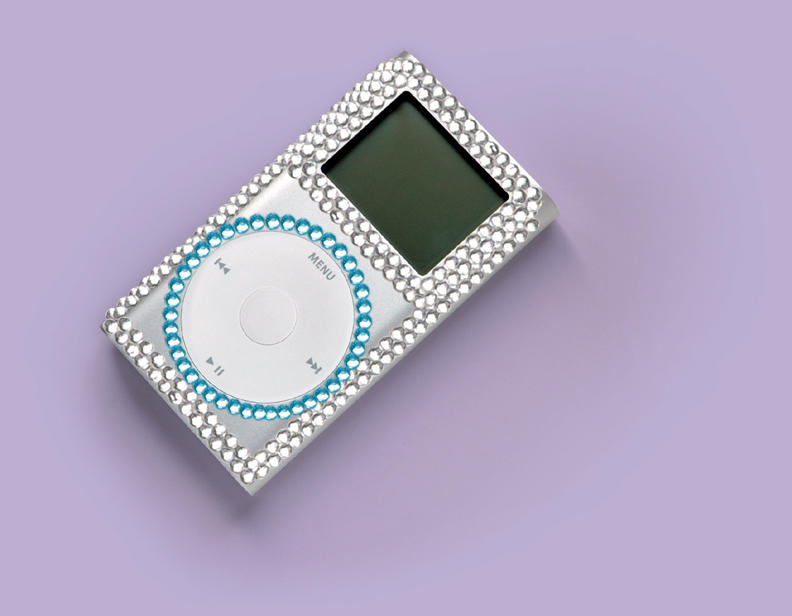
Well, I took the plunge and bought an iPod. Let the "I told you so's" begin in the comment section! Of course being the top of the line kind of guy that I am I went with the 60 gig and the Monster Cable tape adapter for the car. All music will be encoded with Apple lossless compression. I'll be using it as my own radio station for my commute to work, put it on random and forget about it. What made me finally decide to do it? Well this weekend I'm going on a business trip to Maine and I wanted to have some tunes. Also, recently at work I have been selling lots of highend headphones to iPod users. A number of customers have asked me if the iPod is capable of running these 'phones and I tell them that many other customers have had great results. With an iPod I can let them hear for themselves, it only makes sense. I wanted the model below but they were out of stock.
My good friend Clint is the one who introduced me to the iPod. In the same way that a crack dealer entices new customers he handed it to me and said, "just hold it" then when we were leaving to go out for the night Clint grabbed the iPod and said, "let's take my entire music collection with us." I was sold. The Stereophile reviewed sealed the deal. Some quick thoughts on my experience:
The apple iPod may be single-handedly supporting the American economy. It wouldn't surprise me if it has saved Apple. I wonder if we'll see more people buying Macs because of their positive experiences with the iPod.
The Apple store in the mall was easily the busiest store in the mall. There must have been 50 customers in the store at all times. You had to fight to talk to a salesperson. When I asked the gentleman who helped me if it was busier than usual he said that it was kind of slow at the moment.
You could easily spend more on accessories for the iPod than the iPod itself.
You can hack an iPod to do anything. There are even maps for transit systems in major cities that you can download onto your iPod. Now if only they could figure out a way to get pornographic videos on this thing they would really have something.
I'm amazed that you can store 60 Gig on something this small. I remember when my then roommate Duane first got a Jazz Drive and was flabbergasted* to have 1 Gig of storage space! That was less than 10 years ago.
They give you the coolest bag that I have ever seen to carry your purchase. No need to clutter up your hands, just throw it over your shoulder. My friend Duane must love shopping there, I know how he hates to carry things in his hands.
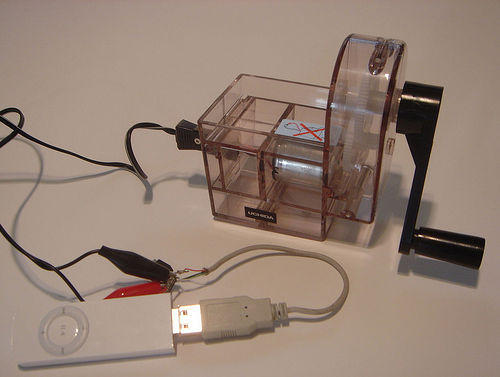
Unfortunately they were out of the charger that I wanted. There is a picture of it below.
*I spelled flabbergasted right without spell check.
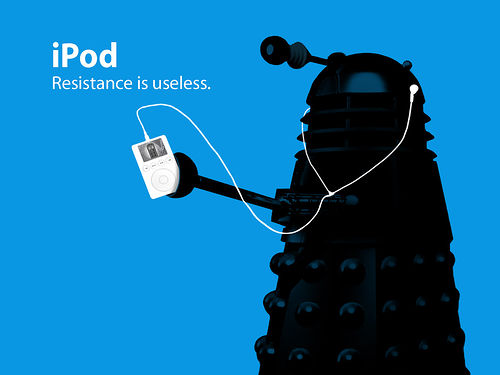
Even the Doctor's biggest enemies, the Daleks are getting iPods. Is it part of their next insidious plot against the Doctor?
I came across this image while doing research for the purchase of an iPod sometime in the near future. The thing that clinched it was my co-worker who is as much a fanatic about sound as I am. He is also a recording engineer. He tested Apple's lossless compression and came to an interesting conclusion. Not only does it work bit perfect, the uncompressed signal is MORE accurate that the original. How is this possible? Well the process of compressing and uncompressing the signal greatly reduces a phenomena called digital jitter. A certain amount of jitter is introduced into every CD during the manufacturing process.
Robert Harley in his book "The Complete Guide to High-End Audio" defines digital jitter as follows: "Timing variations in the clock that synchronizes events in a digital audio system. The clock could be in an analog-to-digital converter that controls when each audio sample is taken. Of more interest to audiophile is clock jitter in digital audio reproduction; the clock controls the timing of the reconstruction of digital audio samples into an analog signal. Jitter degrades musical fidelity."
This has led me to think about ways of digitizing my entire music collection onto an iPod and then running that into a high-end DAC (Digital to Analog converter.) Apple's wireless iPod accessory might do the trick but more research is needed. Who need a remote control? I could literally hold my entire CD collection in my hand with instant access to any piece of music in my collection without ever leaving my chair. Of course it would also sound better than the original CD because of the reduction in jitter. Very interesting. This is definitely worth more thought.
All of this from just wanting to be able to listen to some tunes on the way to work.
Many of you may think that this is a change in my stance against MP3s. What I am against is highly compressed music of dubious legal origin. I object to not only the bad sound quality but also the theft of the artists intellectual property. With Apple's Lossless compression and CD's from my own collection neither of these is an issue. The idea of less than CD quality is pretty objectionable when you consider that CD performance is, in and of itself pretty compromised.
Digital Sources: Primare D20 CD player (used as a transport) and Theta DSP Pro Basic III DAC. Analog Sources: Pro-Ject 1.2 Turntable fitted with Audioquest sorbothane record mat mounted with a Grado Gold Cartridge and a Pro-ject Phono Box phono stage. Tandberg 3011A FM Tuner. Preamplifier: Adcom GFP-750 Amplifier: Threshold Stasis S550e Power Conditioner: Panamax Max-5510 Speakers: Martin Logan CLS Cables: Audioquest Panther, Jade and Quartz interconnects, Audioquest Gibraltar speaker cable, DIY hand-terminated true 75 ohm digital cable. Transparent Power Link Plus power cords on Power Conditioner, Transport, DAC, Preamp, and Amp. Audioquest AC15 powercords with Wattgate ends on speakers. Tweaks: Ayre wood blocks under all components, except speakers. Non-upgraded power cords have Audioquest Noise Stoppers installed. All unused inputs on preamp are filled with DIY shorting RCA plugs.