Don't get all up in arms he only uses records that are already to damaged to be playable. Check out his website here.
Sunday, September 28, 2008


Friday, September 26, 2008
The making of Led Zeppelin LP's
Below is a short video on the making of the recent "Mothership" and "The Song Remains the Same" records.
Thursday, September 25, 2008
We're Gonna Groove

Today marks the 28th year since the death of John Bonham and the end of Led Zeppelin. John was a family man who hated touring and the rock star lifestyle. He preferred to go to the local pub and talk to farmers about how every body's crops were doing. He didn't just own a farm, when he wasn't recording or touring he worked his farm. He was as proud of his prize winning cows as of his gold records. There are many stories about his angry outbursts but for the most part he was depressed about being away from his family. Everyone who knew him described him as a warm and giving person.
Led Zeppelin had one of the most varied list of influences imaginable. Bonham and Jones were into Soul, R&B, and Jazz. Plant loved Blues, West coast psychedelia, pop, and Indian Music. Page was fascinated by Blues, Early Rock N' Roll, Folk music, and world music. When people call them the first Heavy Metal band that's an insult. No heavy metal band has their knowledge of music history or their ability to play just about any type of music they decided to attempt. How many band could play blues, folk, hard rock, punk, reggae, country, and pop? Add to all of those the songs that simply defy categorization.
In interviews both in 1980 and since every band member has admitted that they felt that the band was stagnating and they were hungry to explore new directions and conquer new territory. Were they on the verge of another great period or were they about to head down a creative dead end? If their track record was any indication another great success was in their future. They were always risk takers. Even ending the band was a brave move. They had to know that none of them would ever achieve that level of success as individuals. Led Zeppelin is perhaps unique, with the exception of The Beatles in the fact that they decided to end it and go out on top. A wise move as no one would have been able to fill Mr.Bonham's drum stool. They never won a Grammy during the band's existence, they have since been honored with a Lifetime Achievement award.
Tuesday, September 23, 2008
A giant among men
Sadly many people haven't heard of Les Paul. In addition to being a great guitarist he is a great innovator and even an inventor. He invented the solid body electric guitar, thus greatly reducing the problem of feedback on stage. He also invented the idea of over-dubbing allowing one musician to record many parts for a single work. Not to mention his innovation of synchronizing a number of recording machines to allow for multi-track recording, thus making mixing after the performance possible. Modern recordings simply couldn't exist without his vision.
Tuesday, September 16, 2008
Seriously?
Have you ever wondered what review's systems look like? Below are pictures of Robert E. Greene from "The Absolute Sound" two systems.
System 1:

Harbeth speakers on make shift stands, Bryston amp setting on the floor, components stacked on top of one another and a turntable that's on a flimsy looking stand. This can't be the recipe for great sound. Sadly this isn't a joke.
System 2:

Looks to be a Bryston Preamp sitting on top of a Sunfire amp (a H-U-G-E, HUGE no-no because the power supply of the amp MUST be radiating noise into the preamp which contains delicate signals) hooked up to a cheap direct drive turntable and a cheap looking CD player all setting on a fire place mantle.
None of this is to say that those systems can't sound great but the chances are very, very slim. Now, for a few pictures of MY system from a couple of years ago. While not perfect the set up is much closer to what the majority of the audiophile community would consider ideal. Lacking a digital camera this is the best photo that I can provide.

Monday, September 15, 2008
Wearing the Inside Out

Today it was announced that founding member of Pink Floyd, Richard Wright passed away after a short battle with cancer. While he didn’t have many song writing credits after "Dark Side of the Moon" or many appearances as the lead singer his contributions behind the keyboards defined the Pink Floyd sound. It's absence from their album "The Final Cut" insured that album's failure as a "Pink Floyd Album" and guaranteed that it would forever be seen as a "unofficial Roger Waters solo album." With only a small guest appearance on "A Momentary Laps of Reason" he couldn’t stop that LP from being anything more than a David Gilmour solo album that had Mick Manson doing a bit of drumming. His full return for the "Division Bell" album revitalized the sound for a new phase of the band that was far too short. It is impossible to imagine a singer more perfect for harmonizing with and complimenting David Gilmour's voice so seamlessly. The song Echoes from The Floyd's highly underrated Meddle is a prime example. His 1978 solo album, "Wet Dream" which is unjustly out of print is a wonderful collection of songs well worth the trouble of seeking it out. Mr. Wright's family released only a short statement and asks for privacy.
At the very end of "Time" Richard Wright sings
"Every year is getting shorter, never seem to find the time.
Plans that either come to naught or half a page of scribbled lines.
Hanging on in quiet desparation is the English way.
The time has gone, the song is over, thought I’d something more to say . . ."
Plans that either come to naught or half a page of scribbled lines.
Hanging on in quiet desparation is the English way.
The time has gone, the song is over, thought I’d something more to say . . ."
Wednesday, September 03, 2008
Methodology

Acoustic music is better at diagnosing the sonics of a component simply because the listener has had a chance to hear it in real life. I've always felt that if a component could reproduce the tonality of acoustic instruments accurately, their reproduction of the tonality of electronic instruments must inherently be accurate. However, I would agree that if a trained listener had heard a recording of non-acoustic instruments on a system that is known to be extremely accurate because of it's performance with recordings of acoustic instruments in real space enough times that they could then use that recording with some authority.
Don’t get me wrong it isn’t a bias against rock and pop, or a preference for jazz and classical. It is perfectly acceptable to use acoustic rock as a reference. Drum kits on rock and pop are, as long as they acoustic also a perfectly acceptable instrument to use for evaluation purposes.
While the sound of an electric guitar MIGHT be as complex as a flute, acoustic guitar, or grand piano it is unknowable. By that I mean that unless you were in the recording studio with the guitar player on the day of the original session your understanding of the sound of that guitar can only be in the broadest of terms, not exact terms. There are just too many variables that affect the tone of the guitar. The list of factors that I can think of off of the top of my head are:
1. The Guitar (make, model, and year)
2. The switch positions on said guitar
3. The nob settings of said guitar
4. Custom modifications to the guitar (if any)
5. The foot pedals (not only type but brand)
6. The nob positions on those pedals
7. Any customization of those pedals (if applicable)
8. The Guitar amp (make, model, and age)
9. The setting of knobs and switches on said amp
10. Any customization of the amp (if there are any)
11. Recording mic (model and type)
12. Mic position
13. Tweaks of the mic (if any)
14. Room position of mic
15. Room acoustics
16. String choice on guitar
17. Choice of guitar pick
18. Tube type in guitar amp (if applicable)
Now lets look at the variables for recording a flute:
1. The flute (make model, and year)
2. Recording mic (model and type)
3. Mic position
4. Tweaks of the mic (if any)
5. Room position of mic
6. Room acoustics
Because there are so many variables in the way an electric guitar CAN sound it is completely unsuitable as a reference to determine the accuracy of reproduction. So if a piece of audio gear slightly changes the tonality of electric guitar it’s tough to know because the slightly inaccurate reproduction is still somewhere on the continuum of what an electric guitar MIGHT sound like. It’s pretty obvious that the chance KNOWING in exact terms how a particular performance on electric guitar is supposed to sound is an impossibility. While KNOWING how a flute is supposed to sound in absolute terms, though difficult is possible.
Tuesday, September 02, 2008
Thursday, August 21, 2008
Hearing vs. Listening

The average audiophile's HEARING isn't any better than the average person. However, our LISTENING abilities are much more refined. Our brains have become extremely practiced at analyzing the data that interests us. Hearing is a physical action. Listening is a cognitive, analytical action. Like when we were kids and our parents said, "You don't listen." They were right we heard that they were speaking to us but we didn't bother to remember what they said. We just didn't think that it could be important.
Just a quick thought.
Just a quick thought.
Wednesday, August 20, 2008
Sunday, August 10, 2008
An Invitation

Writing is an activity that has always brought me much enjoyment. From High School through College each of my English teachers encouraged me to make it my profession. There have always two major obstacles. First, my skepticism about how an individual can making a good living as a professional writer (The bohemian lifestyle holds no romance for this rampant consumer) and second the creative muse only seems to visit me when there is an assignment, preferably one with a deadline. Douglas Adams once declared, " I love deadlines. I like the whooshing sound they make as they fly by." But for me there is a strong internal drive to meet my obligations at all costs that trumps my natural laziness.
Recently an opportunity has presented itself to write about topics for which I have no shortage of opinions. Bigblackdisk.com is focused on supporting Mom and Pop record stores, Indie Rock, Hi-Fi, and vinyl records. If there is someone that you know would enjoy my writing or has an interest in those topics please forward this email to them. The site goes live on August 15th and I hope that all of you will join me. Feel free to leave comments good and bad. If you want me to know which comments are yours simply post with your first name and last initial. As a preview to entice everyone to check it out I’ve included the introductions to my first four reviews. You’ll have to stop by on August 15th to read the rest, just call me a tease. ;-)
Black Keys-"Attack & Release"
Is heavy, riff based Rock back in style? If the likes of The White Stripes, Wolfmother, Secret Machines, and The Black Keys have anything to say about it the answer is a rousing “Hell Yes!” Recorded in just 14 days, the Black Keys’ “Attack & Release” has a strong DIY feel from the water color and pencil cover to the hand built recording console that was used during the sessions.
The pressing is an extremely quiet and utilized the half speed mastering technique. Included with the record is a copy of the album on CD, at $18 the package is a bargain. Other artists should take note, it’s a nice touch for many reasons. It makes importing into iTunes a snap, listening to it in the car easy, it aids in the comparison of vinyl vs. CD for those on the fence, and it comes in handy for loaning to friends who are curious about the band. After spending the last several years servicing other people’s turntables it’s doubtful that I’ll ever lend out my records. The number of people who feel that it’s appropriate to put spare change on top of their tone arms in order to make sure that it tracks or are completely missing the diamond of their stylus is just plain alarming. Records, like girlfriends and wives are not for lending. Use the CD to help spread the word, cherish and hoard the record.
Jeffery Lewis-"12 Crass Songs"
It was once remarked in my presence that if an old painting was put into a new frame it forced the view to re-evaluate the work from another perspective. That's exactly what Jeffery Lewis' "12 Crass Songs" sets out to do. Jeffrey Lewis re-interprets 12 songs by punk band Crass as folk tunes. It's not such a strange idea as it first seems, in some ways punk and folk are closely related. Both genres are democratic musical forms. Anyone can form a punk band or become a folk troubadour. Being able to play an instrument competently , follow a melody, or in anyway sing are strictly speaking optional. All one really needs is a quick fire vocal delivery that's almost fast enough to slip by the standard left wing observations as being profound. A skill perfected by Bob Dylan.
Guster-"Ganging Up on the Sun"
Hidden on Chicago's FM dial is one of the most eclectic stations in the country. Driving with the windows down on a forgotten Saturday afternoon WXRT played the Cure's "Just Like Heaven", Muddy Waters' "I'm a Man", and Queen's "Fat Bottom Girls" back to back to back. How many radio stations would play these three songs in the same year, let alone as part of the same set? XRT displays the same passion and courage when championing new talent. They freely lend their support to Guster and many other under-exposed artists. If you're thinking about being jealous, don't. Through the miracles of the internet it's now available world wide, make sure to send Al Gore a nice thank you note written on a palm leaf using soy ink, delivered by Pony Express. Maybe he'll read it while riding on a private jet to one of his $175,000 speaking engagements. Remember do as he says, NOT as he does and Mother Earth will be just fine.
Guster's "Ganging Up on The Sun" is a meticulously recorded and mixed, ambitious pop album lovingly crafted to induce toe tapping. By the second or third listen the album already sounds familiar, like an old favorite. Except of course it isn't, it's a brand new favorite. . .
Mark Knopfler-"Shangri-La"
Mark Knopfler is such a fluid, tasteful, and literate guitarist that he makes it sound easy. This more than anything else accounts him being one of the most under-rated guitarists plying his trade today. He never uses his well formed technical abilities to needlessly dazzle, his gifts are only utilized to serve the song. Not only is Mr. Knopfler an instrumental virtuoso, he is also a compelling song writer. Imagine the pick of Stevie Ray Vaughn and the pen of Pete Townshend and the level of Mr. Knopfler's talents come into focus. Not only is he a great talent, but his modesty allows him to be surrounded by performers of similar talent. Just so my biases are clear to all I wrote the above before compressed carbon met this helping of dead dinosaur for the first time. So I guess that you could say that I'm predisposed to like the disc.
About half of the songs on Shangri-La have a common theme, but not to worry it avoids stepping over the line to become a pretentious concept album. The majority of songs are about the struggles of the working class and their exploitation at the hands of the Bourgeoisie. For me listening to an album about the plight of the working class on a system that costs more than many people make in a year is the source of a bit of chagrin. But if Mark Knopfler is comfortable making more on said album and associated tour than those same people make in a lifetime I guess I can soldier through my guilt.
Tuesday, July 29, 2008
Bose?

Bose is a great marketing company that makes mediocre (at best) speakers. First of all, I believe that most would agree that they start their design from a flawed premise. They've always said that 7/8 of the sound we hear is reflected, as apposed to direct sound. This is why most of the drivers in a 901 face in odd directions. Ask anyone from Bose where this number comes from and they can't tell you. This is creating false space as apposed to recreating the space that is actually captured on the recording. Then you have their active equalizer that is there to compensate electronically by forcing drivers past their physical limits to get a "big" sound out of a small box. This MUST create distortion. This is only one of the products, the others are equally flawed.
Then you look at their tendency to sue people for the most goofy reasons. They sued CEDIA (Consumer Electronics Design and Installation Association), a trade association of which they are a member for the use of the word "Lifestyle" with respect to audio. Years ago they sued Thiel because they used that same model number. Which is just stupid because the whole idea copyrights is to avoid confusion in the market place. Who in the world is going to confuse Bose and Thiel? Especially when the speakers looked completely different and were designed from a completely different technical point of view?
The following is from Wikipedia, "In 1981 Bose unsuccessfully sued the magazine Consumer Reports for libel. Consumer Reports reported in a review that the sound from the system that they reviewed "tended to wander about the room." The District Court found that Consumer Reports "had published the false statement with knowledge that it was false or with reckless disregard of its truth or falsity" when it changed what the original reviewer wrote about the speakers in his pre-publication draft. The Court of Appeals reversed the trial court's ruling on liability, and the United States Supreme Court affirmed in a 6-3 vote in the case Bose Corp. v. Consumers Union of United States, Inc., finding that the statement was made without actual malice, and therefore there was no liability for libel." I can't believe that they sued someone for a bad review!
Then you look at their draconian approaches in retail such as insisting that their products MUST NOT be set up where they can be actively demoed against other brands and their Secret Police tacts of demanding that managers fire sales people that say anything remotely negative about their brand ON THE SPOT or risk being cut off as a dealer. Neither of these things are myth, I've seen them happen!
Saturday, July 26, 2008
Lots to think about

Wilson Audio is one of the pillars of the High-end audio industry. The following video makes it clear that David Wilson, Wilson Audio’s guiding light has profound thoughts about a great number of topics involving the industry other than speaker design. The half hour video addresses such subjects as the difference between a product vs. a commodity, the financial transparency and solvency of Hi-Fi manufacturers, business models, fair pricing, real customers vs. customers of opportunity, perceived quality vs. real quality, De-localization, corporate social responsibility, labor rates, and shop efficiency. Click on the photo below to attend the lecture.

Friday, July 18, 2008
Maybe I'm amazed

My Martin Logan CLS electrostatic speakers are now powered by the Audioquest AC15 power cords that I recently mentioned. Each was broken in by using them to power my Threshold Stasis S550e amplifier for 24 continuous hours. There is no contest between the Monster Cable PowerLine300 that I was previously using and these. The first thing to strike me is how much more quiet the backgrounds are with the AC15s in place. On Belle & Sebastian’s “It Could Have Been a Brilliant Career” the gentle hums and buzzes of the guitarist’s tube amp is clearly audible in the right channel as he waits for his turn to enter the song. The acoustic guitar also has more body behind the strings and the piano sounds fuller too. These cords have also made the soundstage more spacious, increased the shimmer around cymbals, and allowed music with lots of layers to really reveal itself much more effortlessly. They’ve also gotten rid of the extremely slight sibilance that female vocals could occasionally take on.
Gone is a slight muddiness on cello that I always noticed on Jacqueline Du Pre and the London Symphony's transcendent performance of Elgar's Cello Concerto in E minor, Op. 85 conducted by Sir John Barbirolli. The unwelcome hardness of the dynamic peaks at the very beginning of the second movement have also been tamed and sound much more effortless.
The audible effects of power cords continue to amaze me. How much of these changes are due to the ferrite clamps, how much do the Wattgate connectors contribute, how much of it is just the better wire in the cable. It would be hard to know for sure but the overall effect is nothing short of jaw dropping!
Saturday, July 12, 2008
Keep this Train rolling


My love affair with analog FM radio is well documented on the blog. However, the ability of internet radio to bring variety and diversity to everyone around the world is thrilling, even if the sound isn’t. Tivoli radio has been making some of the most compelling and innovative table radios for a couple of years running. Their new NetWorks radio clearly demonstrates that they have no intentions of slowing down. The NetWorks allows the user to listen to internet radio anywhere that there is a wired or wireless internet access. But it doesn’t stop there, this new addition to the Tivoli stable can also find music files on your PC and play those too. It also has a USB port to play songs off of portable media players.
Wednesday, July 09, 2008
White?

Led Zeppelin's newly remastered "The Song Remains the Same" is being released on four 180 gram LP's. The latest version of the album includes 6 bonus tracks not on the original album including "Black Dog", "Over The Hills and Far Away", "Misty Mountain Hop", "Since I've Been Loving You", "The Ocean", and "Heartbreaker." Also orders through ledzeppelin.com by July 22 have a chance of being randomly selected to receive the release on white vinyl, which is limited to 200 copies. Isn't white supposed to be for virgins?
Thursday, July 03, 2008
A good deal for skeptics
It would be hard to find a topic more controversial and debated in high end audio today than the effect (or lack there of) of power cords on sound. The discussion of the contribution of power cords to the overall sound of a system has been discussed many times on this blog. When I first started my forays into this phenomena I didn't want to hear a difference, because I'm cheap and I'm a natural skeptic. However, my brand of skepticism is more of an “open-minded skepticism” so investigation was clearly in order. For those looking for an inexpensive way to do some experimenting HCM audio has a closeout deal on Audioquest AC15 power cords at an unbelievable price, $39.95 for a seven and a half feet power cord. As a bonus, they are fitted with WattGate/Marinco 5266, ends. Much nicer than what Audioquest originally offered as the standard terminations.

The AC15s includes a ferrite bead to help stop RFI and EMI from getting into the components. They will be replacing the Monser PowerLine300 on my Martin Logan CLS speakers. Audioquest has been my cable of choice for a number of years now. In addition to being one of the oldest cable companies in existence, they always make clear what makes one level of cable better than the next. Their staff is more than willing to make custom cables to any specifications and to complete and ship them extremely quickly. Take a couple minutes and read this short interview with Audioquest founder Bill Low.
Thursday, June 26, 2008
Ebb and Flow
Bill Shafer sent along a nice video about the resurgence of the vinyl record. Like the ebb and flow contained in the grooves of our favorite records those black discs have risen and fallen and risen again in popularity over the years. It's out lasted reel to reel tape , 8-track, cassette, DAT, and Minidisc. The way things are going it's starting to look like the record will outlast the CD too. Now wouldn't that be ironic.
Tuesday, June 24, 2008
Kid Rock is Right?
Rarely, if ever do I agree with Kid Rock. But he makes his point very succinctly in this youtube video.
Stealing music is wrong. You heard it here first kids!
Sunday, June 22, 2008
Impending disaster at Capitol Tower

Los Angles may be close to loosing a land mark. In a city where almost nothing is old and a general sense of history is lacking, Capitol Studios is under threat. The Capitol Tower was designed by architect Welton Becket and opened in 1956 at 1730 Vine Street. A developer has purchased the land next door and intends to build a 16 floor condominium high rise, complete with underground parking. That subterranean parking would only be 18 feet away from the legendary echo chambers. The construction would make the chambers and studios unusable, at least temporarily. Of more concern is that the traffic in the garage might make them permanently useless. These are the very echo chambers and studios used on recordings by Frank Sinatra, Nat King Cole, The Beach Boys, Ray Charles, Louis Armstrong, Ella Fitzgerald and countless others.
The builders originally went to great lengths to make the studio as acoustically isolated from the surrounding as possible. The rectangular first floor that houses the studios is actually a separate structure, joined to the tower after completion. The exterior walls are 10 inch thick concrete with a 1 inch air gap separating the outer structure from the studio’s inner walls. The studio floor floats on a rubber-tiled 3 inch thick concrete slab, which itself floats on a layer of cork supported by a 6 inch concrete slab. The heating and air conditioning system use decoupled ducts, sound traps, and specialized vents. Even the ballasts for the fluorescent lights were mounted outside the studio to eliminate any source of hum. Les Paul designed the echo chambers, using similar construction methods 30 feet underground. They are capable of creating echoes that last for up to five seconds. It would be a shame if all of this hard work and good design was made obsolete so some yuppies can have a posh pad with underground parking.
For those in the LA area Capitol is encouraging people to turn out and show their support at a zoning meeting for a stay of execution. The Planning and Land Use Management, or PLUM (If only politicians would spent less time thinking up cute anachronisms and more time solving problems maybe we’d have better government.) is meeting Tuesday June 17 at 2 PM at City Hall in hearing room 350. The fate of Capitol records studios may very well be in our hands.
 .
Wednesday, June 18, 2008
Pure Power
For the last couple of years PS audio has been making some of the most exciting and innovative power conditioning products on the market. In the video below PS audio's founder Paul McGowan takes us on a tour of their Power Plant Premier.
I had a Power Plant Premier in my system for a month recently. The drop in the noise floor was unbelievable. The recording that sticks most in my mind was Paul McCartney's "Unplugged." The tonal shifts in his voice as he would move his head to talk to either the audience or the band were always audible, however with the Power Plant Premier the changes were astounding. Sound staging depth was also dramatically increased throughout the album. One detail that I had never noticed before nor have I heard since was the sound of McCartney shifting his feet between songs. Micro dynamics also became much more evident.
PS audio is currently offering a free DVD entitled "Coal to Coltrane: a Brief History of Power." Anybody that is interested in high end audio should request a copy. It's full of insight and anecdotes from Wes Phillips, Michael Fremmer, Robert Harley, and many more. The documentary not only demonstrates the basic principles of electricity it also explains how and why we have the electrical system that we do today. The program isn't a fluff piece selling merely PS audio's products, in fact it rarely mentions their wares. It could easily be shown on PBS, it's that educational and historically informed.
Saturday, June 14, 2008
Avant-garde

Avant-garde musician David Byrne, formerly of the Talking Heads sets out to prove that music is all around us by turning an abandoned building into a musical instrument. The whole space is playable by a keyboard. For whatever reason when I heard about this I knew it had to be in New York. Originally posted by boingboing.
Thursday, June 12, 2008
Grado

Wednesday, June 11, 2008
T Bone Burnett

In an interview with New York’s WNYC, Producer T Bone Burnett expounds on his dislike for the CD. "It's stepped down from tape to digital to compressed digital, so people are now listening to a Xerox of a Polaroid of a photograph of a painting." For future releases of Burnett’s projects he intends to release a CD packaged with a DVD that will include DVD-Audio and files in a number of formats including 24/96, 16/44.1, AAC, and MP3. The files will be encoded from the original master instead of the process so eloquently described by Mr. Burnett. All for the same price as a conventional CD release. Too bad it wasn’t ready for the Robert Plant & Allison Krauss release “Raising Sand.” Hopefully it will be re-released in the new format.

Thursday, June 05, 2008
A new resource


Lately I’ve been completely addicted to wikipedia, whenever something piques my curiosity it’s my go to resource for quick answers. nearly everything you’d want to know about anything is there. Any subject, that is except audio. Even the entries on companies like Mark Levinson, Dynaco, Audio Research, and McIntosh are extremely short. Then there are important companies that have no entries whatsoever.
Enter Audiophilewiki. Started in May of this year, Audiophilewiki is looking to change all of that. Right now it’s in an embryonic state but with such industry luminaries as Harry Pearson, Robert Harley, Ray Kimber, Tim de Paravicini, Michael Fremer, Paul McGowan, Ken Kessler, and EveAnna Manley the talent and the passion is certainly there. For a good list of topics that already up in some for or another click here. Now go and help make it pretty!
Enter Audiophilewiki. Started in May of this year, Audiophilewiki is looking to change all of that. Right now it’s in an embryonic state but with such industry luminaries as Harry Pearson, Robert Harley, Ray Kimber, Tim de Paravicini, Michael Fremer, Paul McGowan, Ken Kessler, and EveAnna Manley the talent and the passion is certainly there. For a good list of topics that already up in some for or another click here. Now go and help make it pretty!
Friday, May 30, 2008
Revolution!
Jim Thiel is one of the most innovative speaker designers of all time. He bases all of his designs on common sense and hard science, not marketing. Instead of coming out with a new line of speakers every three years or so, Thiel chooses to wait longer and release speakers that are revolutionary as apposed to evolutionary. The dizzying number of finish options are all well done and allow those who worry about aesthetics to have a large number of choices. They even go as far as to offer custom matching of existing wood work. Does the wife have an 18th centaury armoire that she insists be matched? No problem. Send the nice folks in Lexington Kentucky a sample and in about a week or two they will send back three samples with pricing for each.
Thiel’s newest speakers, the CS3.7 is a masterstroke. For a company whose speakers have always been very seamless owing to their time and phase coherent design the 3.7 takes it to the next level. The vanishing act that these speakers pull off is quite startling. Like all Thiel speakers they do take quite some time to break in. Many believe that the extended break in time required is related to the metal drivers and the solid core wiring used through out the line.
The new 3.7 is significantly more efficient than it’s predecessor, providing twice the output from a given amount of input power. The most technologically innovative aspect of the 3.7 is it’s midrange driver which has response all the way up to 20kHz. The traditional tweeter that lies at the center of the midrange driver is there mostly to improve dispersion. The new midrange driver’s ripples also are unique and add a great amount of structural strength, which reduces distortion. Below is an interview with Jim Thiel conducted by Ken Dawkins. He discusses many of the facets that make his new speaker a technological tour de force. Click on the picture to view the video.

Saturday, May 24, 2008
Compromise worthy of a politician

It seems that there is no end in sight when it comes to the battle of which sounds better, the CD or the record. There are those who feel that CD’s will never be able to sound like a record. There are others who ask why would anyone want them to. Then there’s Aleks Kolkowski, with an idea worthy of a politician. He offered attendees of Manchester Futuresonic 2008 Festival a 45 rpm single that was cut onto a useless CD or DVD. Even going as far as to offer people the chance to bring a WAV file of their choice. Now if only useless old laserdiscs could enjoy the same “treatment” we could have some 33 1/3s as well. Many vinylphiles will enjoy the irony, yet cringe at the thought of what playing one of these would do to an expensive phono cartridge.
Thursday, May 15, 2008
Rough Mix

The ability of music to instantly and powerfully remind us of a very specific time in our life is one of its most magical qualities. For me “Rough Mix” will always be inextricably linked to a drive between Indianapolis and Lexington Kentucky with my friend and former boss Duke. There’s nothing like a road trip with good tunes to get to know someone. He brought the album along as an evaluation tool when we were visiting the manufacturing facility of Thiel Audio. When we got back into town he lent it to me. I enjoyed it, returned it then promptly forgot all about it. Until a saw it again 8 years later, I just had to buy it.
The story began when Ronnie Lane of “The Faces” approached his friend Pete Townshend of “The Who” for a loan. Townshend declined but offers to work with Ronnie on an album instead. Initially Ronnie thought that he would produce a solo album for him but Pete had little interest in sitting behind the console. Mr. Townshend offered to do a joint album (stop your snickering DAMN IT!) and recommends Glyn Johns to produce.
Rough Mix is anything but! There are lots of layers, a virtual tapestry with everything perfectly in it’s place. For the most part it’s an intimate album with hushed, almost confessional vocals. It’s an album of quieter moments. Choosing to whisper the truth instead of scream nonsense. This is all the more surprising when one considers the number of guest musicians. None of whom try to call attention to themselves, instead they chose to contribute tastefully. Special guests include Charlie Watts of “The Rolling Stones”, Eric Clapton, John Entwistle of “The Who”, Ian Stewart sort of from “The Rolling Stones (see foot note*)”, and future Who member John “Rabbit” Bundrick.
The Pete Townshend contributions are universally strong. “My Baby Gives It Away” is mid-tempo rocker. “Misunderstood” can be said without a trace of irony to have the perfect amount of cowbell. It also contains other nice percussion touches. The harmonica also adds a nice counter point to his vocals, and what’s not to love about the chorus (“coolwalkingsmoothtalkingstraightsmokingfirestoking.”) “Street in the City” is a nice little song about the goings on during the day on an average street with a nice little string arrangement. “Heart to Hang on to” has some nice moments of vocal interplay between the pair and a nice brass interlude. “Till The Rivers All Run Dry” is just beautiful and is a great example of a cover so perfectly chosen and performed that the artist really makes it their own.
I find the Ronnie Lane contributions less moving. The sole songwriting collaboration between Lane and Townshend is an instrumental called “Rough Mix” where Eric Clapton singularly fails to do anything interesting and John “Rabbit” Bundrick upstages everyone with his performance on the organ. “Annie” has a nice sad Irish drinking ballad feel to it, which is added to by the accordion and violin. For whatever reason his song “Catmelody” sounds like an outtake from “The Rocky Horror Picture Show” intended for Meat Loaf, the sax solo really seals it too. I would add “in a bad way” to the previous sentence but I feel that it goes without saying since we‘re talking about Meat Loaf. “April Fool” really benefits from Clapton’s Dobro playing, which is a nice touch. The bonus tracks, while not essential are nice to have too. All three of the outtakes have a loose audio-vérité feel that adds to their charm.
The sound of acoustic guitars are not just strings, but the body behinds the strings and the pick against those strings. The album also has quick accurate bass, and extended shimmering cymbals. While the dynamics are not overly compressed, if they were a little more open this album would go from great for a Rock recording to exceptional for a Rock recording. The newest version of the disc is a Dual Disc that in addition to it‘s DVD-Audio layer (The DVD-A is 24/48 for surround and 24/96 for stereo. In addition it has Dolby Digital stereo and surround for backwards compatibility.) also features a short documentary. The default on the DVD-A side is multi-channel, unforgivable from the two-channel audiophile without a monitor perspective.
*He was kicked out for not being cool enough though he continued to record with them and play with them live. Maybe Mick didn’t want to split the money six ways. Sorry but I simply never pass up a chance to take a shot at Mick Jagger, even a cheap unfounded one.
Wednesday, May 07, 2008
Knowing your roots
Originally written December 6, 2006, now with pictures!




Recently I was afforded the opportunity to visit the Pavek Museum of Broadcasting in St. Louis Park, Minnesota. The museum began life as the private collection of Joseph R. Pavek. A traveling salesman that made it a regular habit to stop into every small town barber shop for a quick trim and to ask the same question, "Do you know anyone with an old radio they don’t want?"In Mr. Pavek’s day the barber knew everyone in towns business.


There were a plethora of interesting exhibits. The first that springs to mind was a musical performance that was recorded simultaneously for acoustic 78RPM record (A horn captured the sound which was then cut directly into the master. No electricity was necessary) and electrical 78RPM record (Microphones and something approaching modern recording technics.) flipping between them was a snap. Of course the electrically recorded version had much better bass response, a more transparent midrange, and more a more accurate presentation of brass instruments. The gentleman guiding the tour briefly mentioned that when electrical recordings made their debut felt that they were markedly inferior to the old acoustical recordings. Thus was born Audio Luddism.


The next exhibit that inspired my imagination was when our tour guide was nice enough to play a Bing Crosby recording on an early Ampex ¼” reel to reel tape deck using a Marantz 5B tube amp and a huge pair of Western Electric horn speakers that were originally designed for movie theater use (I would estimate that the mouth of these horns was roughly 5’ by 7’, yes I meant feet!) The sound was stunning and immediate! Apparently, Mr. Crosby was an early investor in Ampex, supporting an American GI that had brought back some German machines after World War II. He used the Ampex machines to record his radio show so that he could complete it on his schedule, not allowing himself to be a slave to the time slot.


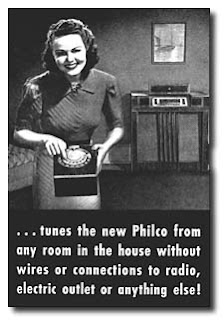
Perhaps the most amazing item on display was a Philco radio from 1939 It featured six AM presets and a wireless RF remote, that used a rotary dial similar to what was used on telephones. The range, an astonishing 200 feet! Something that would have been amazing had it been working was a 78RPM record changer that would play one side of the disc, then flip it to play the other side automatically. Unfortunately it had malfunctioned the previous day snapping a shellac in two, just my luck.


Perhaps the most amazing item on display was a Philco radio from 1939 It featured six AM presets and a wireless RF remote, that used a rotary dial similar to what was used on telephones. The range, an astonishing 200 feet! Something that would have been amazing had it been working was a 78RPM record changer that would play one side of the disc, then flip it to play the other side automatically. Unfortunately it had malfunctioned the previous day snapping a shellac in two, just my luck.


In one of the earliest examples of decorators trying to hide audio systems as to not ruin the décor of a room was a 78RPM turntable disguised as a lamp. The shade hid the turntable, and the body of the lamp was a brass horn that emitted the music. It was also a working lamp. The sound, well let’s just say that it was the Bose of it’s time. Feel free to draw your own conclusions.
Also on display was an original Theremin utilizing all tube electronics. I was even granted permission to "play" it. That was a very cool experience. I’m no Jimmy Page, let me tell you. Another interesting tidbit was a Mechanical Television with a resolution of 48 lines (If I remember correctly.) It consisted of a spinning disc drilled with holes and an eye piece that the view looked through. Broadcasts were over AM radio frequencies and most viewers built their own "televisions."
If anyone is in the St. Louis Park, Minnesota area a visit is mandatory. My tour was courtesy of Tom Mittelstaedt who was obviously equal parts passionate and knowledgeable. The Pavek is located at 3515 Raleigh Avenue in Saint Louis Park, just east of Highway 100, off the West 36th Street exit. They are open to the public five days a week and are also available for special tours and evening meetings. Call the Museum at (952) 926-8198 to make reservations for group tours or just stop in for a visit. Their website is www.pavekmuseum.org It’s not to be missed.


Saturday, May 03, 2008
As it should be

Paul McCartney-”Unplugged (The Official Bootleg.)" Unfortunately it was never released in the US so you will have to buy it as an import. It's worth it, I promise. It is not a bootleg, that’s just a tongue in cheek title. It was recorded during an MTV unplugged appearance, and released by Parlophone. The entire album is what unplugged is supposed to be, all acoustic instruments! The album preserves the witty between song banter, re-tuning of instruments, moving of microphones, etc. It’s easy to hear that everyone involved is having a great time, including the band. The audience is very respectful, yet excited. One of the most natural and engaging live albums that I have ever heard. The sound quality is extremely high. There is a minimum of compression and great sound staging depth. As Paul turns around to direct comments to the band or steps away from the mic the tonality of his voice changes. Also when he messes up the lyrics of an old Beatles song the frustration in his voice is apparent, as he apologizes to the audience. Geoff Emerick did a great job in the engineering and mixing department. The material is a mixture of old rockabilly, Beatles material, and early McCartney solo work. This album is priceless.
Subscribe to:
Posts (Atom)